
The phrase marksman rifle gets used loosely, which is why so many people talk past each other when they compare it to a sniper rifle. In real military terms, a designated marksman rifle is meant to fill a specific gap, not to compete with a dedicated precision system.
Think of it as the squad’s reach extender. A standard infantry rifle is optimized for closer, faster engagements, while a sniper system is built for deliberate shots at much longer distances, and the marksman role lives between those two realities.
What A Marksman Rifle Actually Is
A designated marksman rifle exists to push a squad’s effective engagement window farther out than a standard service rifle. In most frameworks, that means it’s built for targets roughly in the 300 to 600 meter range, where ordinary carbines start running out of practical precision.

A designated marksman isn’t a sniper—it’s a squad shooter tasked with higher-confidence hits at extended range while still moving and fighting with the unit. That difference in mission is what shapes everything from the rifle’s action type to its optic choice.
The History Behind The Role
The role didn’t begin as a marketing category. It emerged from a simple battlefield reality: within a moving infantry unit, someone needed the ability to reach past the typical rifleman’s comfort zone and neutralize high-value targets.
The Soviet approach to squad-level marksmanship in the mid-twentieth century formalized that idea, and the Dragunov SVD is often cited as the first purpose-built platform for the designated marksman job. Western forces took longer to standardize the concept, moving from accurized service rifles into more specialized DMR platforms as doctrine and equipment caught up.
How Marksman Rifles Differ From Sniper Rifles
The first difference is tempo, and tempo drives mechanics. Most marksman rifles are semi-automatic because the designated marksman needs to take quick follow-up shots and sometimes engage more than one target without breaking the rhythm of a moving element.
Sniper rifles tend to be bolt-action because the priority shifts from speed to first-round precision. A bolt action’s simpler operating cycle, rigid lockup, and fewer moving variables support consistency in the kinds of shots where a miss can’t be corrected with a fast second trigger press.
Accuracy expectations also diverge in a way that surprises people who only compare barrel length and caliber. A marksman rifle is often expected to deliver around 2 MOA or better, which is far more precise than a standard service rifle but not held to the sub-MOA standard that defines a dedicated sniper system.
That isn’t a shortcoming so much as an intentional design target. A DMR often starts from a service rifle lineage, then gets the modifications needed to make it more precise without turning it into a slow, specialized platform that no longer fits the squad.
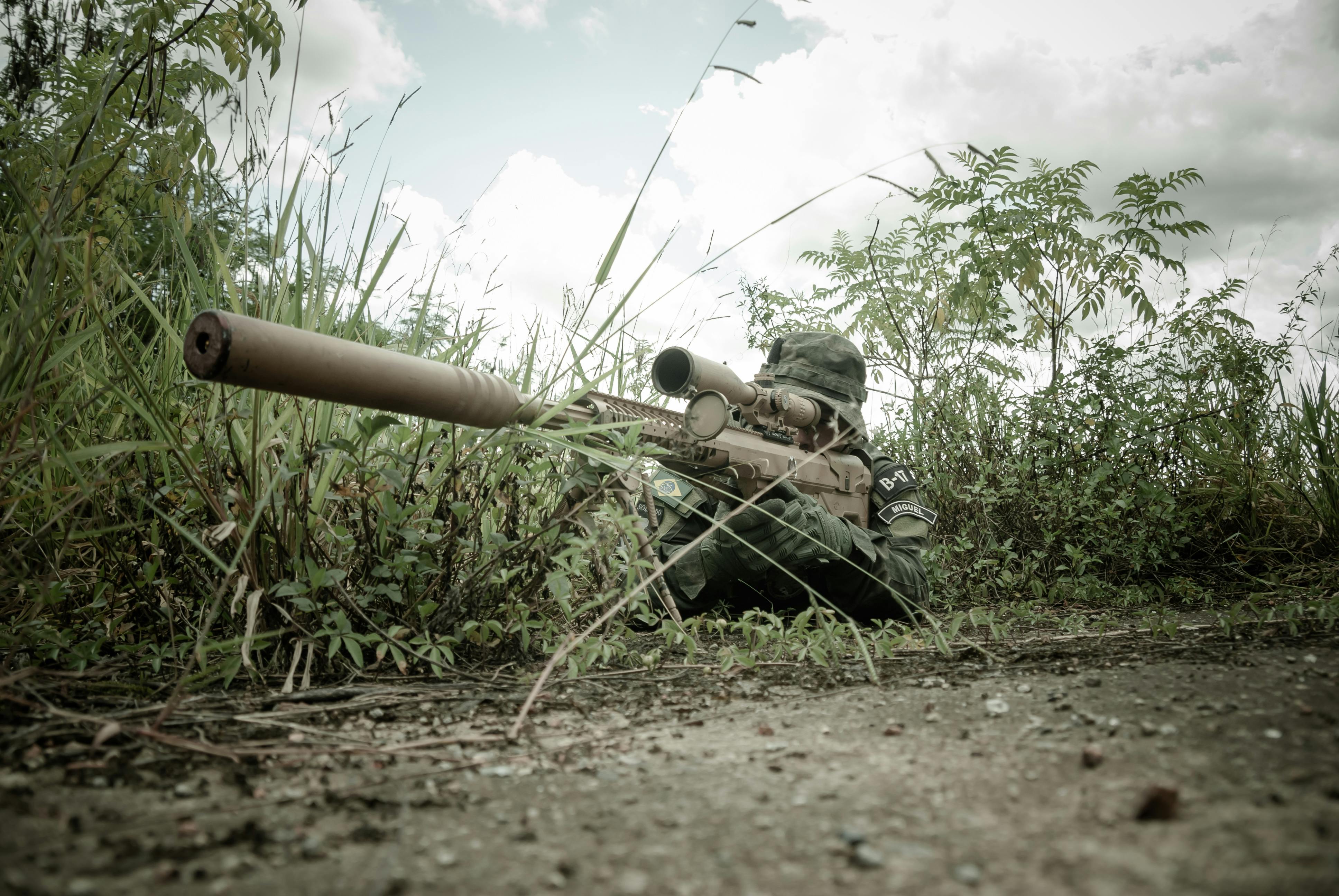
Optics follow the same logic. Marksman rifles commonly wear low-power variable optics in the 1–6x to 1–10x range because the shooter needs a usable sight picture both up close and out toward the edge of the DMR window.
Sniper platforms carry higher magnification because their engagement distances demand it. At those ranges, the optic isn’t just for seeing the target better, it’s part of the ranging and correction system the shooter uses to place a precise shot on a specific point.
Caliber choices reflect logistics and mission, not just ballistics. Marksman rifles usually stay close to what the unit already feeds, often centered on 7.62 NATO for compatibility and resupply simplicity.
Sniper rifles move toward cartridges chosen for downrange performance rather than shared logistics, because the mission is precision at distance instead of integration within a squad’s ammunition ecosystem. That’s why the sniper category stretches from .308-class cartridges into more specialized long-distance options as requirements increase.
Finally, there’s the question of how the rifle fits inside a unit. A designated marksman typically carries a rifle that shares controls and handling with the rest of the squad, so the shooter stays interoperable and mobile.
A sniper system is deliberately different. It’s optimized around precision, concealment, observation, and deliberate engagement, which often means a platform that looks and behaves nothing like the average service rifle.
Where The Marksman Rifle Hits Its Ceiling
A marksman rifle does its job extremely well inside its intended window, and that window is the key point. Once distances consistently push past roughly 600 meters, the compromises that make a DMR a great squad tool start showing up as limitations.
Accuracy math makes this easy to visualize. If a rifle holds around 2 MOA, the practical group size grows as distance increases, and what felt precise at 400 meters can become “combat acceptable” rather than truly surgical at the far edge of the envelope.
The action type also matters more as distance grows. Semi-automatic systems introduce additional mechanical variables compared to a bolt action, and those variables become harder to ignore when the goal shifts from “hit a target area” to “hit a precise point reliably.”
Then there’s ballistics. If the cartridge choice was guided by logistics and standardization, it will eventually run out of the stability, energy retention, and trajectory forgiveness that more specialized cartridges provide when distance becomes the defining factor.
What Changes When You Step Past The DMR Window
Once a shooter’s needs move beyond the marksman role, the platform priorities flip. The rifle becomes a precision system first, built for repeatable mechanical consistency, higher magnification optics, and cartridges selected for predictable behavior at extended distances.
This is where long range rifles like the CheyTac SAPP occupy a different category entirely. The idea is not to replace a DMR in the squad role, but to provide a purpose-built platform engineered around sub-MOA standards and the system-level consistency needed when the target distance stops being occasional and becomes the baseline.
In practical terms, that means the rifle, cartridge, optic setup, and shooter interface all get designed around the same outcome. The farther you push, the less room you have for “good enough,” and the more the entire system has to behave like a single engineered tool rather than a modified service rifle.
If you’re choosing between these categories, the clean question is not “which is better.” The clean question is what distance, what tempo, and what level of precision your real use case demands, because that’s where the line between marksman and sniper systems actually lives.
CheyTac USA
+17315356029
24070 US-70, Huntingdon, TN 38344